Friday, July 29

Green Hairstreak

Juniper Hairstreak
Juniper Hairstreak (Callophrys gryneus)

Although this picture is blurry, it shows my strategy for anchoring a bare root Ocotillo to the ground, the problem was that in order to form roots the Ocotillo needed to not move back forth with a breeze (that would break any new roots or worse uproot the entire plant as there was almost nothing underground).  So to counter balance the extremely top heavy canes I drove four stakes into the bed and then tied the top of each stake to cross beams in an "x" pattern that essential put downward pressure on the crown of the plant keeping it quite still no matter how strong the breeze.


Four-nerve Daisy
One of the best native Texan plants I have found for desert landscaping, Four-nerve Daisy (Tetraneuris scaposa). 


Mammillaria heyderi
Mammillaria heyderi  - these are the best tasting fruits of the many native cactus fruits I have tried.  Sweet and tart like strawberries, where most other cactus fruits are too bland for my taste.


Mammillaria heyderi
Mammillaria heyderi -Grows from I-35 West into East Arizona where it forms nearly flat discs in mostly rocky soil.  Fruits can be red or purple, flowers can be white, cream and apparently sometimes yellow (which I have only seen in photographs).

Monday, July 18

Queens vs Soldiers


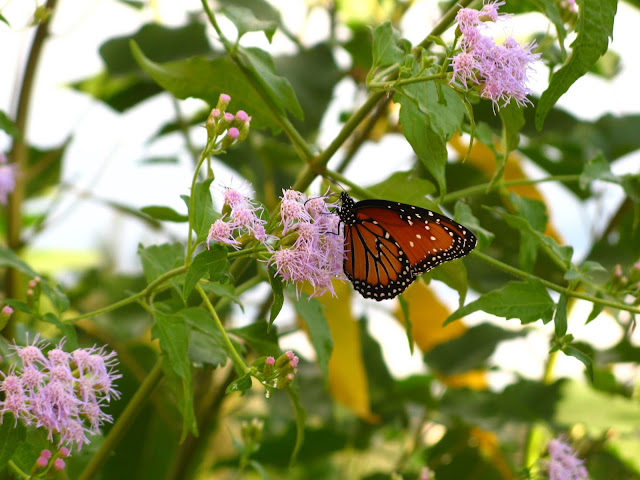
How can you tell whether the butterfly in your garden is a Queen Butterfly (Danaus gilippus) or a Soldier Butterfly (Danaus eresimus)?  Here are a few good sites with better diagnostic illustrations and descriptions than I have provided here:  butterflyfunfacts.com, www.greatstems.com.  I was surprised to learn that most of the butterflies that come to my blue mistflower plants each fall are actually Soldier Butterflies.
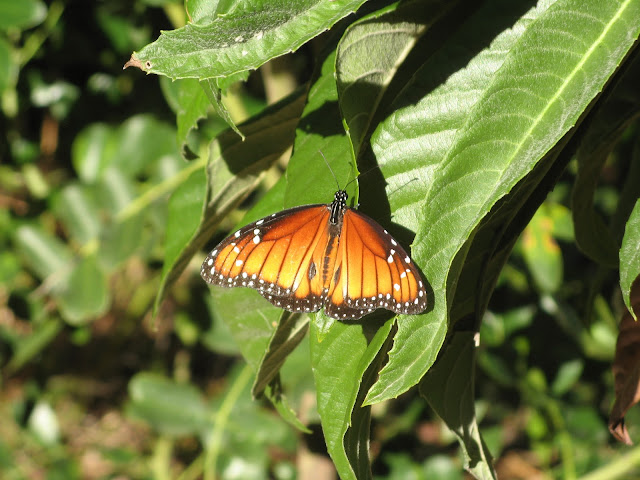

Danaus gilippus
Queen Butterfly (Danaus gilippus) or Soldier Butterfly (Danaus eresimus)?  The lack of white spots in FW postmedian area points to this one being a Soldier.  Most guide books don't put Soldier's beyond a few strays this far North...Global Warming maybe?, there are tons around my house in the fall.


Danaus eresimus, Solider Butterfly
Queen Butterfly in front with a Solider Butterfly behind.


Danaus eresimus
This one is a male (see dark scent patches) and a Soldier (see white faint spots in hind wing).


Soldier Butterfly
Danaus eresimus, Soldier Butterfly


Ariocarpus fissuratus


Danaus gilippus
Danaus gilippus, Queen Butterfly

Wednesday, June 29

Swallowtail and Cactus part 3


Catclaw Cactus
One of my favorite photographs, showing the multicolor transparent spines of this Fishhook Cactus (Sclerocactus uncinatus) bought from Rio Grande Cacti out of New Mexico.  This cactus, also known as the Catclaw Cactus, is native to West Texas, likes it very hot and dry and is hardy to at least 10 degree Fahrenheit.
Mammillaria pottsii


Heraclides rumiko
Heraclides rumiko aka Papilio rumiko

Papilio rumiko
Heraclides rumiko aka Papilio rumiko


Thursday, June 16

Swallowtail and Cactus part 2

Papilio rumiko
I raised this butterfly, a Western Giant Swallowtail (Heraclides rumiko / Papilio rumiko), in a plastic jar during the winter, to my surprise he decided to eclose on a rather cool day.  I took him outside and let him dry his wings in my cactus garden.  He hung out for about two hours (which made him easy to photograph) before flying away when the sun came out.

Heraclides rumiko

Western Giant Swallowtail

Western Giant Swallowtail

Friday, June 10

Swallowtail and Cactus part 1


Western Giant Swallowtail
Western Giant Swallowtail, (Heraclides rumiko) aka (Papilio rumiko).


Papilio rumiko
I spent a long time learning what kind of butterfly this was (since there are several that are very similar).  For those interested in some light reading here is the document that helped me come to my final conclusion A new Heraclides swallowtail (Lepidoptera, Papilionidae) from North America is recognized by the pattern on its neck.


Darth Small
This little cactus (Echinocereus russanthus) is mostly unremarkable, small marooon colored flowers, but today the red glowing spikes were picture worthy.  My new nick name for this guy is Darth Small.


Golden barrel cactus
Golden barrel cactus, Echinocactus grusonii

Friday, June 3

Ferocactus Wislizeni

Ferocactus Wislizeni
Fishhook Barrel Cactus, largest barrel cactus native to Texas (far west El Paso area) hardy to 5 degrees.


Ferocactus Wislizeni
Flowers look like a camp fire.  The cactus stem is apparently eaten in Mexico, chopped into small pieces and soaked in sugar.  I can't imagine that it would make a good candy but I will have to post pone judgment until I can try one for myself.


Coryphantha macromeris, hardy to at least 14 degrees.  Macro being "large" and meris "parts" most likely refers to the spines which are quite large for a Coryphantha.  I have seen pictures of this growing in clumps three feet across, I wonder how long that takes?  It appears to grow about an inch every three years.


Nice combination of blooms from late June, most other cactus bloom much earlier.

Sunday, May 1

Question Mark

Echinocactus horizonthalonius


Echinocereus dasyacanthus (center) and a fruit on the Horse Crippler cactus.


Question Mark Butterfly
Polygonia interrogationis, Question Mark Butterfly, likes to land in my compost pile.


pink cactus bloom
Echinocactus horizonthalonius,